Excellence in Education: Some great questioning stems...
Great questioning is integral to student learning. Questions allow us to formatively assess what a student does/doesn’t know. But many questions fall short. The I-R-E (Initiate-Response-Evaluate) model of questioning is best used to check for factual understanding. In this model teachers tend to do most of the talking and the question becomes more rapid fire. McRel/Marzano found that 71% of the questions asked in classes are at the lower three levels of Bloom’s taxonomy. While these types of questions have a place in the classroom, higher-order thinking questions offer much more.
Deeper learning questions go further and allow teachers to understand how students are applying their knowledge and what problems they are encountering. Higher-order thinking questions make learning more personalized and visible and teach students how to think. These skills are transferable to real-life scenarios where we are challenged to apply our knowledge and think.
Four thought-provoking question stems any teacher can use:
What is a way/How would you...I saw this stem used in multiple ways. In a science class students were asked, What is a way we can determine how much sugar is in a piece of gum? In an IEP meeting it was asked, What are some ways you can show proficiency on these things if it’s not by doing this? Finally in an English class, students were prompted with How would you put this in your own words?
Tell me more/Why do you think that? I’ve seen this one used in many classes as a follow-up that pushes students to expand their thinking and often makes learning more visible to the other students in class. In a math class, I saw Ms. Eisenhauer use it as follows:
After asking student 1 what the answer was, she followed up with, Tell me why you think that’s the right answer. After answering the question, she followed up with another student, You had the same answer, tell me about how you came to your answer?
What’s wrong with…I’ve seen this stem used in two ways. One way was in a corrective action. In Math Analysis Pre-Calculus, after a wrong answer was provided, students were encouraged to discuss the question and answer. Similarly, in an English class a small group of students were asked by their teacher to identify what was wrong with one of their group’s answers. In both cases the teacher stepped back and required students to think it out on their own. The other way I saw this question used was in a history class, where the students were asked, “What’s wrong with this?”
How is this similar/different to...Is there a connection to...Anytime students are required to connect their learning with background knowledge it enables them to make neural and other connections that make learning more permanent.
Keep in mind:
- Asking higher-order questions requires more think time.
- You may want to include the question stems you want to use in your lesson plans.
- Keep it simple meaning simply worded questions are often the best.
Need to Knows
We’ve got something new! Want something included on the Monticello Outlook Calendar, the Monticello website or in the PowerSchool Daily Bulletin (viewed by parents, students and staff)? Please use this link https://goo.gl/forms/bIjfJLKokWPcEHx33
Friday is an anchor day with club periods. Some clubs will be taking pictures during club period. Be on the lookout for information from Ms. McCaskill.
Open Enrollment through November 16.
County surveys on Budget and Calendar: open through November 16
- Take the budget survey
- Review the Calendar Committee’s first draft of the 2019-20 calendar
- Take the calendar survey
Important Dates
Nov 15: Leadership Meeting

Field Trips and SOLs
Nov 12: Last Chance Senior Portraits
Nov 13: ASVAB test
Nov 14: Health and Construction Expos
Nov 15: HMSA Open House
Nov 16: Choose or Lose PVCC Senior
Stat of the Week: Bathrooms
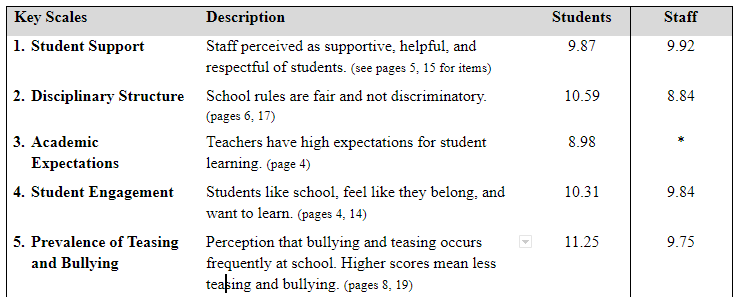
In our peer support survey, students were asked to write any comments or suggestions on school safety. The most common answer was to do a better job of watching the bathrooms. These ranged from check the bathrooms more often to teachers should reduce the number of students they let go to the bathrooms. I know many students have told many of you about problems in the bathrooms, especially Juuling.
So what can we do:
- Ensure we are in the hallways between classes and keep an eye out on groups entering bathrooms, high-noise levels in bathrooms, people spending extended time in bathrooms.
- Administration can check bathrooms more often during class periods (thanks Rita for helping us out already). When on planning periods, teachers can just pop into a bathroom to make sure there are no problems.
- Look for trends and student abuses of break privileges during class. This would include students needing to take breaks every day during class, extended breaks, breaks at the same time, etc. and discuss your concerns with the student from a classroom perspective.
- Teachers who have class meetings, this would be a great item for discussion.
What ideas can you add to the list?
Birthdays
None

Shout Outs
Pass the word: If you didn’t know it our drama students rocked the One Acts. Good luck to the cast/crew in of #WhileBlack in Nashville. Great job Ms. Michel and thank you to all of you who came to Friday or Saturday’s shows.
Shout out to our girls cross country team for their 8th place finish at the state championship.They were led by Lilly Linneweber with a time of 20.00, which is the the 4th fastest in school history, followed by Caroline Wilson, Maria Vizcaino, Sam Lange and Josie Leavell. On the boys side, Will Krehmeyer became the 2nd runner in Monticello history to be named all-state. His time of 16.28 was the 3rd fastest in Monticello history.
Natalya Koppenhoefer recently participated in the Senior Regional Orchestra Event.
Useful Information
Bell Schedules : http://bit.ly/MOHSbells
Morning Announcement Stream: http://streaming.k12albemarle.org/ACPS/links.htm
Worth Your Time