Excellence in Education: Anchor Activities
As a teacher I always wanted more time with my students; knowing this wasn’t something I could control, I wanted to make sure that every minute counted. For me this meant implementing certain structures and procedures such as do nows, efficient transitions, and Anchor Activities.
Anchor activities, which are designed to value student learning and time, serve two purposes. They are designed to either provide students who complete an assignment ahead of others with meaningful--not just more--work or help struggling students get over the hump. For accelerated students, anchor activities should focus on the nice-to-knows for low content and low process students, anchor activities provide extra practice or reinforcement.
Before students began their individual, partner or group work, I posted anchor activities on the board using if statements. If you finish early….If you get stuck with….If you feel you need more practice on (this).....
What are some possible anchor activities:
- Supplementary reading or web sources
- Watching a video (YouTube, Khan Academy, etc.)
- Completing a graphic organizer
- Draw a picture of the process or concept learned
- What if questions/riddles
- Challenge, Higher Order Thinking Questions / Problem-Solving / Project-Based Learning
- Genius time
- Creative writing (Imagine you were…)
- How would you teach this lesson
- Vocabulary
- Practice quizzes
- Flashcards
Anchor activities are important for several reasons:
- They keep students engaged in their learning.
- They allow you to work individually with students or small groups.
- They establish high expectations for students.
- Students will take more ownership for their learning.
- Students are allowed to work at their own pace.
How important is it that we have procedures, protocols and learning expectations? If a teacher increases instructional time by just fifteen minutes a day through the use of more efficient routines, procedures and transitions, students gain 45 hours of instructional time a year (timeandlearning.org).
Post-Script:
We often talk of a guaranteed and viable curriculum (GVC), meaning that same subject teachers agree and have a common understanding of what students must know, understand and be able to do. The task of creating a GVC through our PLCs presents a series of challenges, the largest of which is meeting the needs of our diverse learners. I look at the GVC as the learning that we expect of all students. While aligned with the SOLs, the GVC sometimes lessens the importance of certain SOL strands and often expands upon the SOLs or other learning goals. Anchor activities aimed at high content and high process students are great for those activities that are the nice-to-knows but not required for all students in that class.
We often talk about time in school, which can be broken down into four types:
- Allocated school time (8:55-3:50)
- Allocated class time (time in class)
- Instructional time (time devoted to instruction)
- Academic learning time (time students learn and retain)
What are some ways that you increase Academic Learning Time? School or system wide, what can we do to increase instructional and learning times?
Need to Knows
Telling Our Story
If we don’t tell our story, who will? We do so many great things here at Monticello and it’s important that we highlight and celebrate these.
- We’ve been sending a weekly email to our students about the week’s events and other information. I think it would be great if we use this to highlight some student accomplishments and such. If you have something you’d like to include, please let me know.
- Please share your pictures and stories with John Mitchem, so they can be included in our website and/or Cullen Wade so it can be included in Morning Announcements.
Also we’ve started using the Daily Bulletin feature in PowerSchool. This is used to share information with parents and students, teachers too.

Important Dates
October 18: Parent-Teacher Conferences
October 19: Extended 1st period (8 period schedule)
October 25: CRT Teams Meet
November 2: Making Connections, be on the lookout for countywide email; sign-up early; lunch at morning session’s location
November 5: Green Teacher Work Day
November 6: Stay away sorta’ from School and work from home
Grades due November 8 at 9am

Field Trips and SOLs
SOL Testing (Writing) Begins on Tuesday and runs through October (see Monticello calendar / Cindy’s email for details)
October 25, 26: Virginia Theater Field Trip (see Monticello calendar for list of students)
October 29: 10th grade Career Expo (ALL 10th graders will miss 1st and most of 2nd)
College Visits
Barnard College 10/15 @ 1:30PM
Bryant University 10/16 @ 9:30AM
University of California-Davis 10/16 @ 1:30PM
Bridgewater College 10/17 @ 9:30AM
Bowdoin College 10/18 @ 9:30AM
Davidson College 10/18 @ 1:30PM
Mt. Holyoke College 10/18 @ 1:30PM
Washington University in St. Louis 10/19 @ 1:30PM
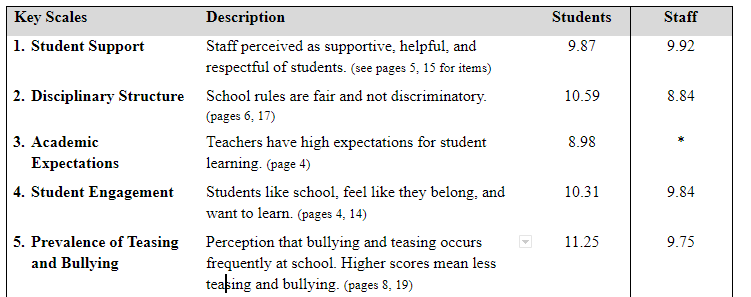
Stats of the Week: State Climate Survey (Student-Student Relationships)
Birthdays
October 16: Garry Gibson
October 19: Jim Huneycutt
October 20: Terry Tomlin
Shout Outs and EdTech Hero

Thanks to everyone for their help with PSAT and CWRA testing. We couldn’t have done it without your help. Thanks for staying positive about these tasks. Paul, Cindy, and Najwa a special super-duper shout out to you!

Useful Information
Bell Schedules : http://bit.ly/MOHSbells
Morning Announcement Stream: http://streaming.k12albemarle.org/ACPS/links.htm
Worth Your Time
The new job for life: learning Some really relevant research and ideas for all of us to reflect on and plan